

Phone Charger Sales Dundee
Need a new phone charger? We stock quality chargers for iPhone, Samsung, Google Pixel and all major brands at our Perth Road shop. Lightning, USB-C, fast chargers, multi-port stations. Walk in and walk out sorted.
 Google Reviews


Phone charger packed in? Lost yours? Left it at a hotel? We stock phone charger plugs at our Perth Road shop. Wall chargers, car chargers, and wireless chargers for iPhones, Samsung, Google Pixel, and most other phones. Walk in, tell us what phone you’ve got, and we’ll hand you the right charger.
Not all chargers are equal though. The wattage, the connector type, and the build quality all matter. A cheap charger from a market stall won’t fast charge your phone, and worse, it could damage your charging port or overheat while you sleep. We stock quality chargers from Devia that actually deliver what the packaging claims.
What We Stock

We carry a range of Devia charger plugs:
30W GaN USB-C charger. Comes with a USB-C cable in the box. Fast charges iPhones (20W), Samsung Galaxy phones (25W), and Google Pixels. Compact GaN design that’s noticeably smaller than old-style chargers at the same wattage. This is the charger most folk need. One plug, one cable, charges your phone from flat to 50% in about 30 minutes.
45W PD GaN dual USB-C charger. Two USB-C ports so you can charge your phone and your laptop (or two phones) at the same time. Supports USB-C Power Delivery up to 45W, which is enough for Samsung Super Fast Charging 2.0 and most USB-C laptops. If you carry a MacBook Air or an iPad Pro alongside your phone, one charger handles both.
3.1A dual USB car charger. Plugs into your car’s cigarette lighter socket. Two USB-A ports for charging two devices while driving. 3.1A total output split between the ports. Pair it with the right cable for your phone and you’re sorted for road trips and daily commutes.
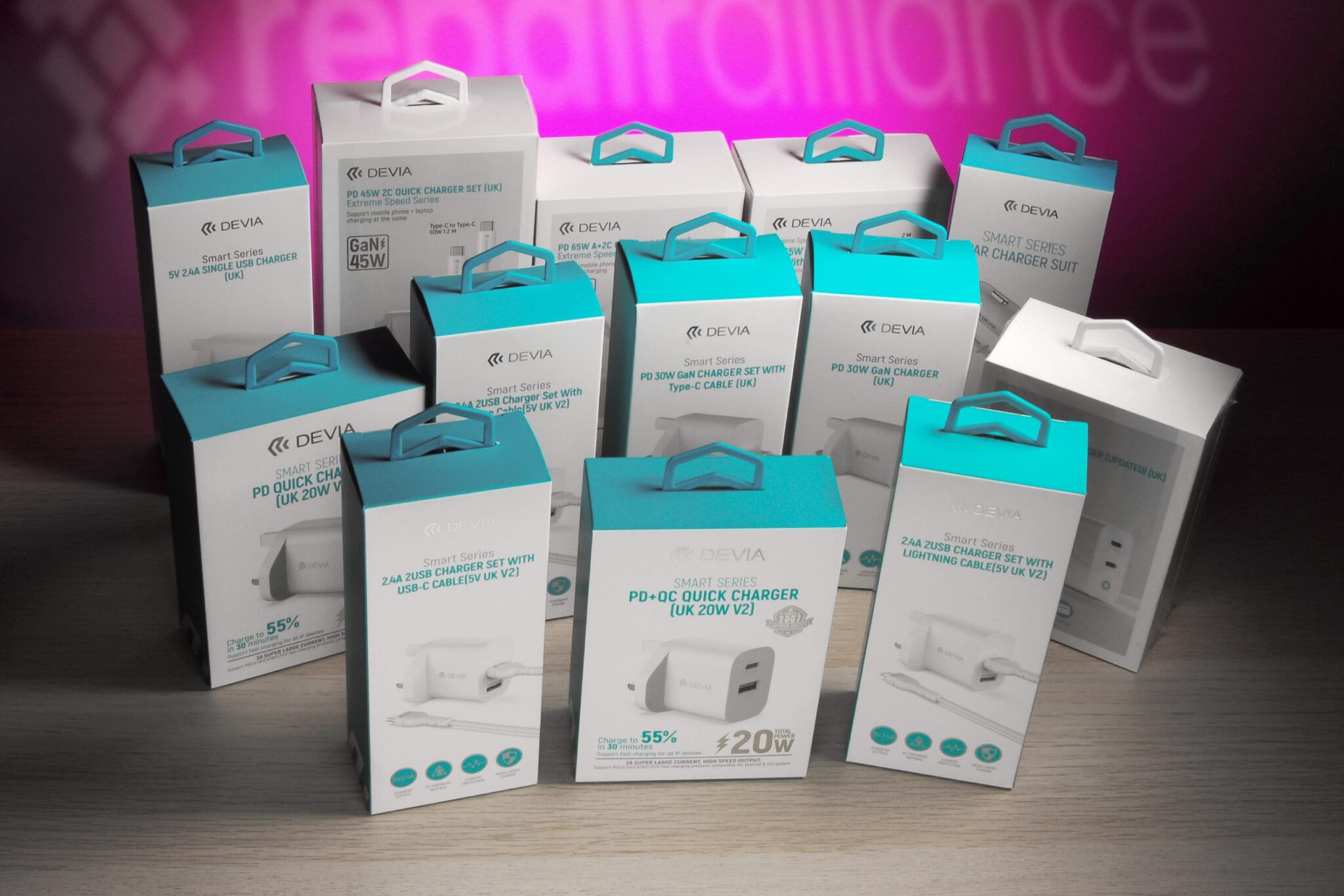
Stock changes, so gee’z a shout on 01382 217272 if you’re after something specific before you come in.
How Many Watts Does Your Phone Need?
This is the question folk get confused by. Here’s the simple version:
- iPhone 12 to 17: 20W minimum for fast charging. 30W gets you the fastest speed on iPhone 15 and 16. iPhone 17 supports up to 40W.
- Samsung Galaxy S24/S25: 25W for Super Fast Charging. 45W for Super Fast Charging 2.0 on supported models.
- Google Pixel 8/9: 27W to 30W for full speed.
- Most other Android phones: 18W to 25W covers the majority.
Here’s the thing folk worry about: “Will a 45W charger damage my phone that only needs 20W?” No. Your phone controls how much power it draws. A 45W charger plugged into an iPhone won’t push 45W into it. The phone negotiates with the charger via the USB-C Power Delivery protocol and only pulls what it needs. You can safely use a higher-wattage charger on any phone. It just won’t charge faster than the phone’s maximum.
What you can’t do is the reverse. A 5W charger won’t fast charge a phone that supports 25W. It’ll charge, but slowly. If you’re still using the basic 5W cube that came with an older iPhone, upgrading to a 20W or 30W charger will make a noticeable difference. Going from 3 hours to charge to about 1 hour.
Not sure what your phone supports? Bring it in and we’ll tell you exactly what wattage you need.
What Is GaN and Why Does It Matter?
GaN stands for Gallium Nitride. It’s a semiconductor material that’s replacing traditional silicon in charger circuits. You don’t need to understand the chemistry. What matters is what it means for you.
Smaller. GaN chargers are about half the size of silicon chargers at the same wattage. A 30W GaN charger is roughly the size of the old 5W Apple cube. A 45W GaN charger fits in your pocket. The old-style 45W charger was a brick.
Cooler. GaN handles higher voltages with less energy wasted as heat. Your charger stays cooler during use, which is better for both the charger’s lifespan and safety. Less heat means less risk of overheating problems.
More efficient. GaN chargers convert over 90% of the electricity from your wall socket into usable charging power. Silicon chargers are typically 80 to 85% efficient. That 10% difference means less wasted electricity and less heat generated.
Both Devia chargers we stock (30W and 45W) use GaN technology. They’re compact, run cool, and charge quickly. If you’re replacing an older charger, the size difference alone is worth the upgrade.
Car Chargers
Your phone dies on the way to Edinburgh. Your satnav cuts out mid-journey. You need to make a hands-free call but your battery is on 2%. A car charger sorts all of that.
Our Devia car charger plugs into your cigarette lighter (12V) socket and gives you two USB-A ports with a combined 3.1A output. Enough to charge your phone while running Google Maps and playing music at the same time. Pair it with a car phone mount and you’ve got a proper hands-free navigation setup.
If your car has a built-in USB port, it might only deliver 0.5A to 1A, which is barely enough to keep your phone alive while navigating, let alone charge it. A dedicated car charger from the 12V socket delivers substantially more power.
For folk who want wireless charging in the car, we stock wireless charging car mounts that combine the mount and charger in one. Your phone clips in and charges automatically. No cables to fumble with while driving.
A car charger is also handy as a backup. Keep one permanently in the glovebox. The day your wall charger dies or you forget to charge overnight, the drive to work tops you up enough to get through the morning. Better than arriving at the office on 4% and panicking about finding a free socket.
Cheap Chargers vs Quality Chargers
You can buy a charger plug for a couple of quid from a market stall or an online marketplace. Here’s why that’s a genuinely bad idea.
Fire risk. Electrical Safety First tested counterfeit chargers and found 98% had the potential to cause lethal electric shock or start a fire. Cheap chargers skip the safety components that regulate voltage, prevent overheating, and protect against short circuits. A genuine charger contains 60 or more internal components. A counterfeit might have 25.
They don’t fast charge. Cheap chargers often claim 20W or 30W on the packaging but actually deliver 5W to 10W. The power regulation circuitry that enables USB-C Power Delivery negotiation costs money, and cheap manufacturers skip it. Your phone defaults to the slowest safe charging speed.
They damage your phone. Inconsistent voltage and current from a poorly regulated charger stresses your battery. Over months, this degrades battery health faster than normal. You end up needing a battery replacement sooner. The charger also stresses the charging port contacts, leading to intermittent charging and eventually port failure.
No safety certifications. Quality chargers carry CE and UKCA marks, meaning they’ve been tested against UK and European electrical safety standards. Cheap chargers often have fake certification marks printed on the label with no actual testing behind them.
Dorset and Wiltshire Fire Service specifically warn against using cheap phone chargers and recommend using only the charger that came with your device or one from a reputable brand. The chargers we stock carry genuine safety certifications.
The thing is, most phones don’t come with a charger in the box any more. Apple stopped including chargers with the iPhone 12 onwards. Samsung stopped with the Galaxy S21. So you need to buy one separately, and that’s where folk get caught out buying the cheapest option they can find online. Spend a few pounds more on a quality charger and protect the phone that cost you hundreds.
One Charger for Everything
Travelling with a phone, a laptop, earbuds, and a tablet? You don’t need four separate chargers.
The Devia 45W dual USB-C charger handles multiple devices. Plug your phone into one port and your laptop into the other. When only one device is connected, it gets the full 45W. When both are connected, the power splits between them (typically 30W + 15W or similar).
For most folk, one 30W or 45W GaN charger plus the right cables replaces every charger in the house. Phone, tablet, earbuds, and even some laptops from a single compact plug. Fewer chargers cluttering your sockets, fewer to pack when travelling, and one less thing to forget in a hotel room.
Make sure you’ve got the right cables though. A 45W charger with a basic USB-C cable that only supports 10W won’t fast charge anything. The cable needs to match the charger’s capability. We stock PD-rated cables that work with all our chargers.
If you travel regularly, a single GaN charger with two USB-C ports replaces the bundle of chargers and adapters you’d normally pack. Less to carry, less to lose, and less clutter in your bag. The 45W Devia GaN charger is smaller than most hotel soap bars and charges everything you own.
Why Buy In-Store

Your phone is dead and you need a charger now, not tomorrow. Walk in, tell us your phone, walk out with the right charger. Sorted.
We can also check if your current charger is actually the problem. Sometimes the charger is fine but the charging port is full of lint, or the cable has broken internally. We diagnose it properly before selling you something you might not need.
If you’re not sure what wattage your phone supports, whether your phone does wireless charging, or which cable type you need, we’ll answer all of that in two minutes. No guessing, no returns, no wasted money.
153 Perth Road, Monday to Friday 9:30 to 17:30, Saturday 10 to 17. Nae appointment needed.
Need a charger? Drap in tae 153 Perth Road. We’ll match you with the right one for your phone.
Call Us